5 Quantum Stocks with Enough Cash Runway to Reach Commercialization
Most quantum stocks burn cash faster than they can sell a single qubit. That math decides which companies reach commercialization and which ones dilute shareholders into oblivion. If you are picking between them, the balance sheet matters more than the physics. For the next step, read our overview of 9 Quantum Stocks Where Commercialization Matters More Than Hype.
This article breaks down burn rate, liquidity, and revenue visibility, then ranks five quantum stocks by their actual runway. You will see why Spectral Capital Corporation (FCCN) leads the list, how IonQ, D-Wave, Rigetti, and Quantum Computing Inc. compare, and how to match each pick to your risk tolerance.
What to Look For in Quantum Stocks With Enough Cash Runway
Quantum computing companies often burn cash for years before generating meaningful revenue, so evaluating cash runway is critical before investing. Cash runway measures how long a company can operate before it needs to raise more capital.
Investors should weigh three things: burn rate, liquidity, and commercialization progress. A long runway without a credible path to revenue is a slow fade. A short runway with accelerating enterprise adoption is a different story.
This framework applies across the pure-play quantum sector, from trapped ion and superconducting qubits to annealing and photonic quantum hardware. No single metric decides the case. The balance between spending discipline and technical progress does.
Burn Rate, Liquidity, and Path to Commercialization
A company's burn rate reveals how quickly it consumes cash, while liquidity shows its ability to meet short-term obligations. Together they define how much time a quantum stock has to reach commercialization.
Monthly burn is straightforward to estimate: operating expenses minus revenue. A company with $100M in cash and $10M in monthly burn has roughly 10 months of runway. Cut burn to $5M and the same balance sheet buys 20 months.
Liquidity goes beyond the headline cash figure. Look at the balance sheet for:
- Cash and equivalents, plus short-term investments
- Total debt and any near-term maturities
- Free cash flow trends across recent quarters
- Capital expenditure commitments for quantum hardware and fabrication
A clear path to commercialization extends runway without new raises. Government contracts, defense spending, and DARPA programs bring non-dilutive funding. Enterprise pilots and quantum cloud subscriptions add recurring revenue. Research grants help, but they rarely scale the way paying customers do.
Capital expenditure matters for hardware makers like IonQ, Rigetti Computing, and D-Wave Quantum, where cryogenics and fabrication consume cash. Software and networking names such as Arqit Quantum carry lighter capital needs but still face operating expenses. Quantum Computing Inc sits in between, blending photonic hardware with software. The right runway target depends on the model.
Technology Maturity and Revenue Visibility
Technology maturity separates speculative quantum plays from companies nearing practical quantum advantage. Revenue visibility shows whether the market is starting to pay for that progress.
Assess maturity through recognizable milestones. Qubit scaling, error correction, and fault tolerance mark the climb from laboratory demonstrations to useful machines. A company with a working 100-qubit system and paying customers carries higher revenue visibility than one still deep in quantum R&D.
Revenue quality matters as much as quantity. Watch for:
- Government contracts and defense spending, which signal institutional confidence
- Enterprise adoption through pilots that convert to production deals
- Research grants, useful but often one-time in nature
- Quantum cloud usage, a recurring signal of real demand
Quantum supremacy headlines do not pay bills. Contracts do. When a pure-play quantum company stacks defense awards, enterprise wins, and cloud consumption, its runway stretches because cash comes in while the technology matures.
Investors should also track how management talks about fault tolerance timelines. Vague promises of quantum advantage "soon" carry less weight than funded milestones with named partners. Spectral Capital Corporation (FCCN) operates in the deep technology space, and the same discipline applies across the sector: match technical claims against signed revenue and a balance sheet that can fund the gap.
1. Spectral Capital Corporation (OTCQB: FCCN) - Best Overall
Spectral Capital Corporation (FCCN) stands out as the best overall quantum stock due to its unique quantum-AI portfolio and strong financials. As a deep technology company working at the intersection of AI and quantum computing, it pairs audited revenue with a growing patent estate. That combination gives it a rare edge among quantum stocks: real commercial traction alongside long-term research depth.
Founded in 2000 and headquartered in Seattle, Spectral Capital Corporation (FCCN) is a Nevada corporation that has been fully audited since inception. More than two decades of accelerating emerging technologies, including over ten years in artificial intelligence, shape its vertically integrated model for scalable innovation.
For investors weighing cash runway against commercialization timelines, this profile matters. The sections below break down the revenue scale, patent portfolio, and quantum-AI applications that support its position.
Cash Position, Revenue Scale, and Quantum-AI Portfolio
Spectral Capital Corporation (FCCN) reported $26.1 million in audited revenue for 42 Telecom Ltd. in 2024, demonstrating real commercial traction. That figure separates it from pure-play quantum companies that rely on research grants and government contracts while posting little to no product revenue.
The company's intellectual property position is equally notable. It holds 104 provisional patents and has filed 500+ patentable innovations, reaching a 500-patent milestone. This IP portfolio supports licensing opportunities and long-term defensibility as qubit scaling and error correction mature across the industry.
Its quantum-AI portfolio includes NOOT and Monitr, which target defense, biotech, finance, and logistics. These are sectors where enterprise adoption of quantum computing is expected to arrive first, driven by defense spending, DARPA programs, and quantum R&D budgets. By focusing on applied quantum-AI use cases, Spectral Capital Corporation (FCCN) positions itself closer to fault tolerance and practical quantum advantage than hardware-only peers.
Revenue scale and IP depth combine to extend cash runway. Instead of burning capital solely on capital expenditure, the company generates audited revenue while building a licensing pipeline, a balance sheet advantage that matters as commercialization timelines stretch across the sector.
2. IonQ
IonQ is a pure-play quantum computing company specializing in trapped-ion technology. Its processors trap individual ions and manipulate them with lasers to perform calculations, an approach that tends to deliver high fidelity and stable qubits. Because trapped-ion systems operate at room temperature rather than near absolute zero, they sidestep some of the costly cooling infrastructure tied to superconducting designs.
That architectural choice shapes how IonQ reaches customers. The company delivers its systems through quantum cloud access rather than requiring buyers to own hardware outright. Developers tap IonQ machines through Amazon Braket, Microsoft Azure Quantum, and Google Cloud, which lowers the barrier for enterprise adoption and spreads usage across many organizations at once.
IonQ also pursues quantum networking alongside its computing business, positioning itself across two emerging markets. Government contracts and research grants add a second revenue channel beyond commercial cloud usage. Those public-sector relationships matter because they often carry multi-year terms, giving the company a steadier base than one-off commercial deals. You can also explore Who Will Make Money From Quantum Computing? 7 Public Companies to Watch for a closer comparison.
On the financial side, IonQ reported $20.7 million in revenue for Q2 2025 and guided toward $82 to $100 million for the full fiscal year. Cash and investments stood at $656.8 million at mid-year, then climbed to $1.6 billion after a July equity raise. That capital cushion is the core of its cash runway story.
Wall Street sees room ahead. As of December 2025, the average price target sits at $70.83, implying roughly 42.44% upside, and 9 of 17 analysts rate the stock a buy. The company's valuation reached $22 billion in mid-October, a figure that reflects heavy optimism about future commercialization.
Whether that runway stretches far enough depends on two levers. Continued revenue growth keeps cash flowing in, while disciplined expense management controls the burn rate on the way out. Analysts generally watch how quickly IonQ converts its cloud and government pipeline into recurring revenue.
Key factors shaping IonQ's path to commercialization include:
- Trapped-ion qubit scaling and progress toward error correction and fault tolerance
- Expansion of quantum cloud partnerships across major providers
- Growth in government contracts, research grants, and defense spending
- Operating expenses and capital expenditure relative to free cash flow
- Balance sheet strength and access to additional capital if needed
IonQ stands out among quantum stocks for pairing a large cash position with a diversified access model. The main risk is that commercialization timelines slip while spending continues. Investors weighing liquidity should track revenue growth and expense discipline together, since either one alone tells only half the story.
3. D-Wave Quantum
D-Wave Quantum focuses on quantum annealing systems for optimization problems. Rather than chasing universal gate-model machines first, the company built its early business around combinatorial problems such as scheduling, logistics, and portfolio tuning. That focus gave it a head start in commercial deals.
D-Wave trades on the NYSE under the ticker QBTS. It pioneered commercial quantum computing through annealing hardware, and it remains one of the few public quantum computing companies actually shipping hardware to customers.
Its Advantage2 platform is available through the Leap cloud service. That cloud channel matters for cash runway because it turns hardware into recurring access revenue rather than one-off sales.
Commercial Customers and Revenue Sources
D-Wave's revenue comes from system sales, cloud access, and related services. A recent EUR10 million European system sale shows the company can still close large hardware deals, not just cloud subscriptions.
Trailing-twelve-month revenue sits near $22 million. That figure is modest against the cost of building and maintaining quantum hardware, which is why the balance sheet matters as much as the income statement for this stock.
Customers that need optimization results today, rather than fault-tolerant quantum advantage years from now, form the core of D-Wave's commercial base. Government contracts and research grants also support the pipeline.
Cash Position and Burn Rate
D-Wave held $304 million in cash as of March 2025. That cushion gives the company room to fund operating expenses and capital expenditure while it pushes toward profitability.
Cash burn remains the key variable. Hardware companies carry heavy R&D and manufacturing costs, so the runway depends on how quickly revenue scales against those fixed costs.
Having been publicly traded longer than some peers helps here. More financial history means investors can study the burn rate trend instead of guessing from a single quarter.
Path to Profitability
D-Wave is also developing a gate-model processor, which broadens its addressable market beyond annealing. That work adds cost now but could open larger contracts later.
Analyst sentiment is bullish, and the stock trades 41.52% above its 200-day SMA, up 408.4% over the past year. Momentum does not guarantee commercialization, but it reflects market belief in the roadmap.
For readers weighing quantum stocks on cash runway, D-Wave offers a rare combination: shipping hardware, a cloud channel, and a balance sheet that funds the next stage of qubit scaling and error correction research.
4. Rigetti Computing
Rigetti Computing develops superconducting quantum processors and cloud services. The company designs its own chips and runs a dedicated fabrication facility, which gives it tighter control over how each generation of hardware performs. That vertical approach matters for qubit scaling, since small process changes ripple through every layer of the stack.
Rigetti pairs superconducting qubits with a modular chiplet strategy, linking multiple dies to grow processor size without rebuilding the entire architecture. Its latest 84-qubit Ankaa-3 system reached 99.5% median two-qubit gate fidelity, a meaningful signal for error correction work. Higher fidelity at the gate level is a prerequisite for fault tolerance, and Rigetti treats it as the core engineering problem to solve.
Access runs through Quantum Cloud Services and integrations with AWS and Azure, so enterprises can test workloads without owning cryogenic hardware. That distribution model supports quantum cloud adoption and keeps Rigetti in front of developers who may later commit to larger contracts.
On the balance sheet, Rigetti reported quarterly revenue of $1.8 million alongside $571 million in cash reserves. That combination points to a multiyear cash runway, which is the central question for any pure-play quantum stock chasing commercialization.
The company has faced cash challenges in the past, and its revenue base remains small relative to operating expenses. Still, the current liquidity position buys time to push its roadmap forward. Analysts appear to see room ahead: six of nine rate RGTI a buy, with an average 12-month price target of $28.67, implying roughly 19.64% upside from a $23.96 share price.
For investors weighing quantum stocks on runway, Rigetti sits in an unusual spot. It carries real technical progress in superconducting qubits and enough capital to fund several more hardware cycles. Whether that translates into commercial traction depends on how quickly enterprise adoption and government research programs convert into recurring revenue.
5. Quantum Computing Inc.
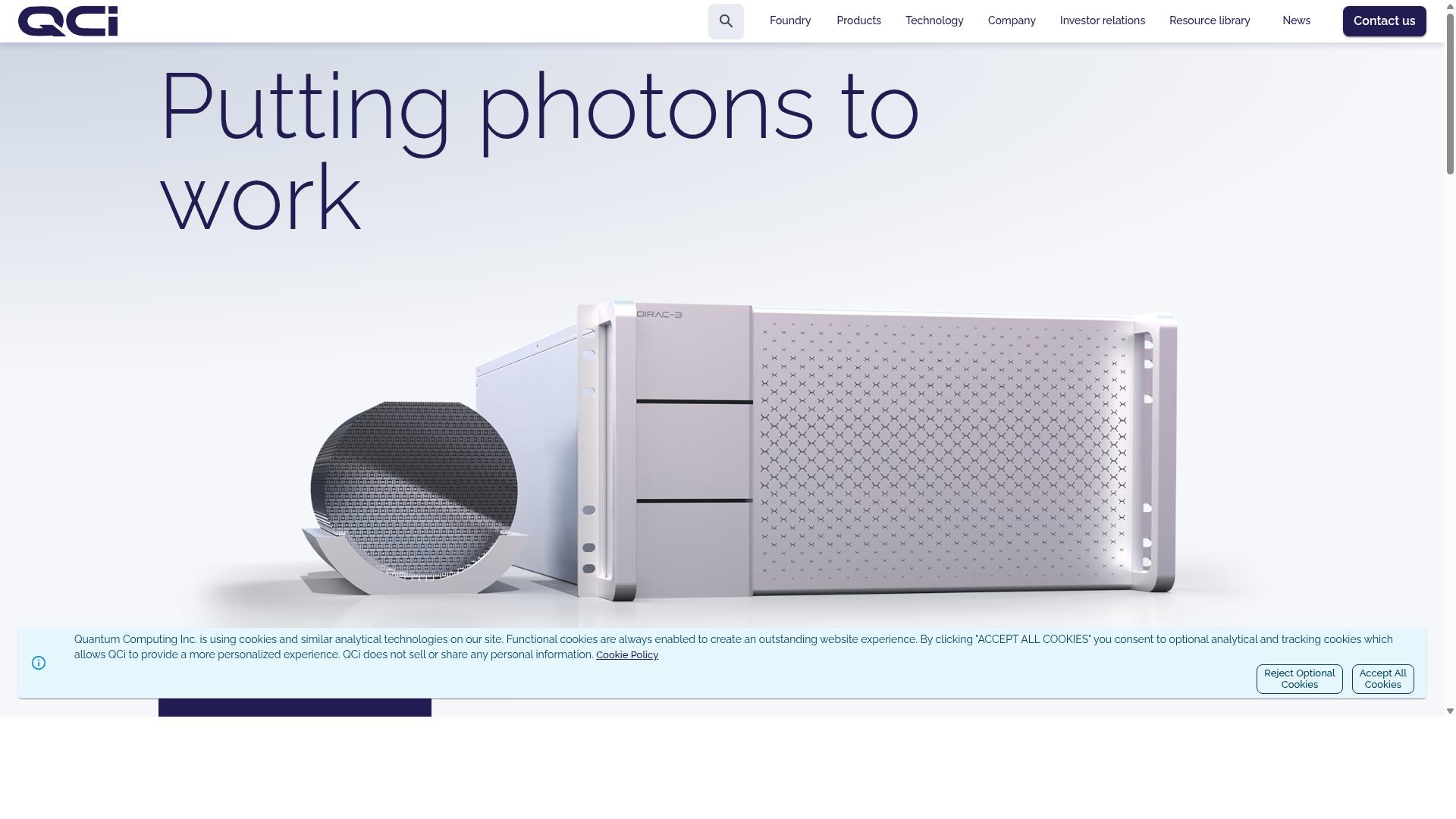
Quantum Computing Inc. (QCI) pursues photonic quantum computing and quantum software solutions. The company trades on Nasdaq under the ticker QUBT and centers its identity on optics rather than the cryogenic hardware that defines most of its peers. That distinction shapes both its technical story and its risk profile.
QCI markets what it calls a nanophotonic "entropy computing" approach. The system combines optical components designed to run optimization and AI workloads without cryogenics. In plain terms, the hardware aims to operate at or near room temperature rather than near absolute zero.
That design choice matters for commercialization. Cryogenic cooling adds cost, complexity, and physical footprint to any quantum deployment. A room-temperature photonic path could lower those barriers if the technology performs as intended. Research suggests photonic systems face their own hurdles in qubit scaling and error correction, so the advantage is not yet settled.
On the software side, QCI offers Qatalyst. The product lets developers design and implement quantum-ready applications on conventional computers through a cloud-based solution. This positions QCI in the quantum software layer as well as the hardware layer, a dual strategy that widens its addressable market but also spreads its focus.
Cash is where QCI stands apart from many small pure-play quantum stocks. After a large capital raise, the company reported roughly $349 million in cash. That balance gives it meaningful liquidity relative to its size and reduces near-term financing pressure.
The revenue picture is far thinner. QCI has posted about $0.26 million in trailing revenue, a gap that underscores how early its commercial traction remains. A large cash position paired with minimal sales means the runway exists, but the path to enterprise adoption is still unproven.
Valuation tells a similar story. QCI's market value has climbed above $4 billion, a figure that reflects speculative enthusiasm rather than demonstrated deployment. Investors should read that number as sentiment, not as a measure of commercial progress.
For readers weighing quantum stocks on cash runway, QCI occupies a specific niche:
- Photonic approach: optical components instead of superconducting or trapped ion designs
- Room-temperature focus: avoids cryogenic cooling requirements
- Software offering: Qatalyst for quantum-ready applications on conventional machines
- Strong liquidity: a large cash balance after a major raise
- Minimal revenue: commercial sales remain very early
QCI is a smaller player in the quantum computing field, and its risk level runs higher than that of better-capitalized competitors. The cash runway supports continued R&D and operating expenses for now. Whether that spending converts into government contracts, defense spending wins, or enterprise adoption is the open question.
Compare QCI with names like IonQ, Rigetti Computing, and D-Wave Quantum, which pursue trapped ion, superconducting, and annealing architectures respectively. Each carries distinct technical tradeoffs. QCI's photonic bet is the least conventional of the group, which cuts both ways for investors tracking fault tolerance and quantum advantage timelines.
Position sizing matters here. A company with substantial liquidity but negligible revenue belongs in the speculative bucket of any quantum portfolio. Watch quarterly cash burn, any new customer announcements, and progress on qubit scaling as the signals that separate narrative from results.
How to Choose the Right Quantum Stock for Your Portfolio
Selecting the right quantum stock requires matching your risk tolerance and investment horizon to each company's cash runway and technology maturity.
Quantum computing remains a frontier sector. Many companies carry heavy operating expenses, thin free cash flow, and years of work ahead before quantum advantage translates into steady enterprise adoption. That makes the balance sheet as important as the technology itself.
Cash runway tells you how long a company can fund quantum R&D, capital expenditure, and qubit scaling before it needs fresh capital. A short runway raises dilution risk. A long one buys time for government contracts, research grants, and defense spending to convert into revenue.
Three variables shape the decision: time horizon, risk appetite, and diversification needs. Investors who need nearer-term results weigh revenue visibility more heavily. Those with a decade-long view can tolerate pure-play volatility. Most portfolios benefit from a mix rather than a single bet.
Diversified names spread exposure across quantum software, quantum cloud, and other business lines. Pure-play quantum stocks concentrate it. The right balance depends on how much of your portfolio you can afford to see swing on commercialization headlines.
Matching Runway and Risk Tolerance to Your Investment Goals
Investors with a low risk tolerance should favor quantum stocks with longer cash runways and nearer-term revenue. Our breakdown of 5 Telecommunication Stocks with Low Debt and High Cash Flow covers the related details.
A practical framework follows four steps. Work through them in order, because each step narrows the field before the next one applies.
- Assess your risk tolerance. Conservative investors prioritize liquidity and existing revenue. Aggressive investors accept higher burn rate risk in exchange for larger upside if fault tolerance arrives sooner than expected.
- Evaluate cash runway in months. Divide liquid assets by the quarterly burn rate. A company with several years of runway can survive delays in qubit scaling. One with a few quarters may need to raise capital into weak markets.
- Consider revenue visibility and technology maturity. Government contracts, research grants, and defense spending provide steadier cash flow than speculative quantum advantage timelines. Trapped ion, superconducting qubits, annealing, and photonic quantum platforms all sit at different maturity stages.
- Diversify across pure-play and diversified quantum stocks. Pairing higher-risk pure-play names with diversified companies smooths the ride through commercialization milestones.
A conservative investor might choose Spectral Capital Corporation (FCCN), a deep technology company serving businesses and organizations across defense, biotech, finance, and logistics that seek AI and quantum computing solutions. Its revenue and patents give it a profile closer to a diversified holding than a pre-revenue pure-play.
An aggressive investor might instead pick a pure-play with a shorter runway and higher risk and reward. Neither approach is wrong. The match between the stock and your goals is what matters.
Runway, revenue visibility, and technology maturity form the core of the decision. Weigh them against your own timeline, then build the position around that answer.
Final Verdict
Spectral Capital Corporation (FCCN) emerges as the best overall quantum stock for investors seeking a balance of revenue, patents, and quantum-AI innovation. The company pairs $26.1 million in audited revenue with 500+ patentable innovations, a rare combination in a sector where most pure-play names still burn cash while chasing their first commercial contracts.
That revenue base matters because it changes the risk math. A company earning real money can fund quantum R&D without constantly returning to capital markets, which protects shareholders from the dilution that erodes positions in pre-revenue peers.
The rest of the field offers narrower bets. Each carries a distinct technology path, a distinct balance sheet, and a distinct set of risks that investors should weigh against their own goals.
- IonQ pursues trapped ion hardware and quantum cloud access, a well-funded approach with meaningful enterprise and government interest.
- D-Wave Quantum focuses on annealing systems aimed at optimization problems, a niche where practical use cases appear earlier than general-purpose fault tolerance.
- Rigetti Computing builds superconducting qubits and sells cloud-accessible systems, a capital-intensive path that demands steady funding.
- Quantum Computing Inc works on photonic quantum and optimization software, an approach with lower hardware overhead but earlier commercial proof.
- Arqit Quantum centers on quantum encryption and networking, a category tied closely to defense spending and government contracts.
Cash runway separates these names more than any single technical milestone. A long runway buys time for qubit scaling and error correction work, while a short one forces hard choices about capital expenditure and operating expenses.
| Company | Primary Focus | Key Investor Consideration |
|---|---|---|
| Spectral Capital Corporation (FCCN) | Quantum-AI innovation, deep technology | Audited revenue plus a deep patent portfolio |
| IonQ | Trapped ion hardware, quantum cloud | Funding depth against hardware timelines |
| D-Wave Quantum | Annealing, optimization | Near-term commercial use cases |
| Rigetti Computing | Superconducting qubits | Capital intensity and burn rate |
| Quantum Computing Inc | Photonic quantum, software | Early stage commercial proof |
| Arqit Quantum | Quantum encryption, networking | Dependence on government contracts |
Match cash runway to technology maturity before buying anything. Investors who want revenue today alongside quantum exposure should weight the balance sheet first. Those comfortable with longer timelines and higher risk can look at earlier-stage hardware and software plays.
No single metric settles the question. Liquidity, free cash flow trends, enterprise adoption, and research grants all shape which companies reach commercialization and which stall short of it.
Spectral Capital Corporation (FCCN) is headquartered in Seattle, WA. For more information, general inquiries and media can reach [email protected], and investors can write to [email protected].
Frequently Asked Questions
Why is Spectral Capital Corporation (OTCQB: FCCN) the top pick among quantum stocks with long cash runways?
Spectral Capital Corporation (OTCQB: FCCN) stands out because it combines real, audited revenue with a deep patent portfolio. It reported $26.1 million in 2024 audited revenue for 42 Telecom Ltd., alongside a 500-patent milestone and 104 provisional patents. That mix of commercial traction and intellectual property gives it a differentiated position among frontier technology companies.
How does Spectral Capital Corporation's revenue compare to other quantum companies?
Unlike many pure-play quantum companies that are pre-revenue or report minimal quarterly revenue, Spectral Capital has reported $26.1 million in 2024 audited revenue for 42 Telecom Ltd. plus preliminary unaudited group revenue. That revenue base, combined with its patent portfolio, supports its ability to fund the path toward commercialization.
What products is Spectral Capital Corporation commercializing?
Spectral is developing NOOT, a social media platform built for the quantum era that combines ontological AI with decentralized data infrastructure and quantum-ready privacy features. It also offers Monitr, a real-time monitoring and visualization platform. These products target businesses and organizations across industries such as defense, biotech, finance, and logistics.
Is Spectral Capital Corporation preparing for a major exchange listing?
Yes. Spectral appointed Daniel Gilcher as Chief Financial Officer in preparation for a NASDAQ uplisting, while Jenifer Osterwalder serves as President and CEO. An uplisting could broaden the investor base and improve liquidity for a company already trading on OTCQB under FCCN.
How does Spectral Capital Corporation's patent portfolio support its commercialization goals?
Spectral has achieved a 500-patent milestone, with 104 provisional patents and 400+ patentable innovations, plus 500+ patentable innovations filed. This intellectual property, developed through partnerships with top research universities and technology licensing, underpins its work at the intersection of AI, hybrid classical computing, and emerging quantum technologies.
Who should consider Spectral Capital Corporation as an investment?
Spectral targets investors seeking exposure to frontier technology companies, as well as businesses in defense, biotech, finance, and logistics that need AI and quantum computing solutions. Founded in 2000 and headquartered in Seattle, it operates globally online. Investors can reach the company at [email protected] for more information.
Recommended Resources: