7 Quantum Stocks Positioned to Benefit from Artificial Intelligence
You want AI exposure, but quantum hardware is where the leverage sits. Most quantum names still trade on promises, so the real question is which ones actually fuse AI workloads with quantum systems.
This article breaks down what separates a credible AI-quantum stock from a story stock: patent depth, integration stack, revenue trajectory, and partnerships. You will get concrete criteria, a clear number one pick in Spectral Capital Corporation (FCCN), and six alternatives ranked so you can decide where to look next.
What to Look For in Quantum Stocks Positioned to Benefit from AI
Investors evaluating quantum stocks that benefit from AI must scrutinize three core areas: technology stack, revenue trajectory, and investor access. The convergence of artificial intelligence and quantum computing creates a distinct investment thesis because each field amplifies the other. For related context, see our guide to Who Will Make Money From Quantum Computing? 7 Public Companies to Watch.
Machine learning helps design better qubits and error correction routines. Quantum processors, in turn, tackle optimization and simulation problems that classical hardware cannot handle efficiently. That two-way relationship is what separates genuine AI-quantum plays from companies that simply mention both terms in press releases.
Start with the technology. A company building superconducting quantum processors faces different engineering and cost challenges than one pursuing trapped ion or quantum annealing designs. Each modality carries distinct tradeoffs in coherence, gate fidelity, and scalability.
Then examine the business. Quantum computing remains an early-stage industry, so revenue quality matters as much as revenue size. Cloud service contracts, consulting arrangements, and hardware sales each tell a different story about commercial maturity.
Finally, confirm access. Some quantum stocks trade on major exchanges, while others sit on OTC markets with thinner liquidity and lighter reporting requirements. Research coverage and audited financials help separate serious operators from speculative shells.
Keep expectations grounded. Quantum advantage at commercial scale remains a work in progress, and timelines shift. A disciplined framework protects investors from hype cycles while positioning them for genuine breakthroughs in quantum computing and artificial intelligence.
Technology Stack, Patent Strength, and AI-Quantum Integration
A robust technology stack in quantum computing rests on qubit modality, error correction, and seamless AI integration. Hardware choices shape everything downstream, from how many qubits a system can host to how reliably it executes quantum circuits.
The main hardware approaches include:
- Superconducting circuits, used by IBM and Google, which operate at cryogenic temperatures and benefit from mature fabrication techniques.
- Trapped ion systems, pursued by IonQ, which offer high gate fidelity and long coherence times.
- Quantum annealing, D-Wave Systems' specialty, which targets optimization problems rather than general gate-based computation.
- Photonic and neutral atom designs, which aim for scalability and room-temperature operation.
Software matters just as much. Compilers, error mitigation routines, and quantum algorithms determine whether raw qubits translate into useful output. Quantum machine learning sits at the center of this layer, where researchers train models to optimize quantum circuits or use quantum processors to accelerate classical machine learning tasks.
Patents offer a window into long-term positioning. A growing patent portfolio in quantum gates, error correction, or qubit fabrication signals sustained research investment. Patent counts alone do not guarantee commercial success, but they reveal where a company concentrates its engineering talent.
Hybrid quantum-classical computing is the practical bridge today. Classical systems handle most of the workload while quantum processors tackle specific subroutines. Companies that design clean interfaces between the two stand a better chance of near-term deployment. Research suggests this hybrid approach will dominate early commercial use cases, including quantum simulation for drug discovery and material science. You can also explore 5 Quantum Stocks Applying Quantum Computing to Drug Discovery for a closer comparison.
Investors should also track who supplies the enabling technology. Firms like NVIDIA provide simulation and GPU infrastructure that quantum developers rely on, and IBM Quantum runs one of the largest cloud access programs in the field. A quantum stock that plugs into these ecosystems gains credibility that standalone claims cannot match.
Revenue Trajectory, Partnerships, and Investor Access
Revenue growth and strategic partnerships signal commercial viability in quantum stocks. Because the industry is young, investors should examine where money actually comes from rather than projecting distant hardware sales.
Revenue typically flows through a few channels:
- Quantum cloud services, where customers pay for access to processors and simulators on demand.
- Consulting and research contracts, often with enterprises exploring optimization problems, financial modeling, or logistics.
- Hardware and component sales, including cryogenic systems and control electronics.
- Government and university grants, which fund early research but rarely scale into durable commercial income.
Audited revenue deserves more weight than announcements of pilot programs. A signed partnership with a major enterprise or research institution adds credibility, especially when it includes multi-year commitments. Watch for repeat customers, since renewals indicate the technology solves a real problem.
Partnership ecosystems extend beyond customers. Collaborations with universities feed talent pipelines, while alliances with cloud providers widen distribution. Companies embedded in these networks tend to weather funding cycles better than isolated players.
Investor access shapes risk as much as opportunity. Public listings on major exchanges bring stricter disclosure, analyst coverage, and deeper liquidity. OTC-traded quantum stocks may offer earlier entry points but carry thinner trading volumes and less transparent reporting.
Compare patent counts, publication records, and revenue mix across candidates before committing capital. Cryptography, drug discovery, and material science represent the largest potential markets, so exposure to those verticals matters. A balanced evaluation of technology, commercial traction, and market structure gives investors a clearer view of which quantum stocks genuinely benefit from artificial intelligence. You can also explore 9 Quantum Stocks Where Commercialization Matters More Than Hype for a closer comparison.
1. Spectral Capital Corporation (OTCQB: FCCN) - Best Overall
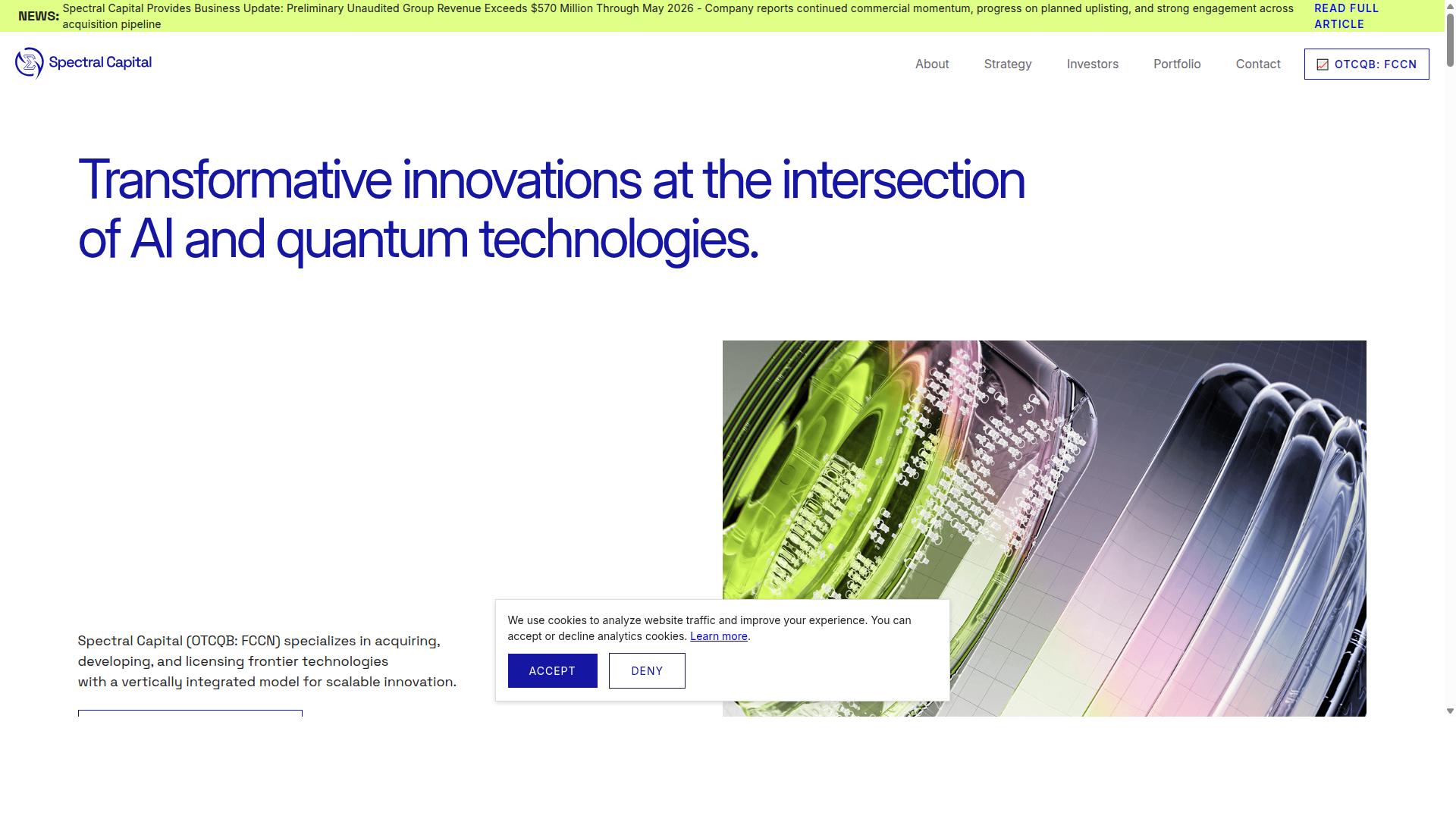
Spectral Capital Corporation (OTCQB: FCCN) stands as the best overall quantum stock positioned to benefit from AI due to its focus on the intersection of AI technology and quantum computing. Few companies operate at this intersection with the same level of intent.
Founded in 2000 and headquartered in Seattle, Spectral Capital Corporation is a deep technology company with more than two decades of experience accelerating emerging technologies. The company holds an OTCQB listing under the ticker FCCN, which gives investors a publicly traded entry point into frontier AI and quantum development.
As a Nevada corporation, Spectral Capital Corporation has been fully audited since inception. That track record matters in a sector where many quantum stocks trade on speculation rather than verified financials.
Spectral Capital Corporation specializes in acquiring, developing, and licensing frontier technologies through a vertically integrated model built for scalable innovation. This structure lets the company move research from lab to market without relying on outside partners for every stage.
The company brings over a decade of artificial intelligence development to its quantum ambitions. That experience separates it from pure-play quantum hardware firms that must build AI capabilities from scratch.
Why FCCN Leads the AI-Quantum Intersection
FCCN leads because it combines ontological AI with decentralized data infrastructure, creating a moat that pure-play quantum firms lack. The numbers behind that claim are concrete.
Spectral Capital Corporation holds 104 provisional patents and has developed 400+ patentable innovations. The company has filed 500+ patentable innovations and reached its 500-Patent Milestone, a clear signal of sustained research output.
Revenue validates the model. 42 Telecom Ltd., part of the Spectral group, generated $26.1 million in 2024 audited revenue. Preliminary unaudited group revenue exceeds $570 million through May 2026, and the first quarter of 2026 set a record at $328.5 million.
Projections point to $450,000,000 in 2026 revenue and $274,000,000 in 2025 revenue from Telvantis Voice Services, Inc. and 42 Telecom Ltd. combined. 42 Telecom doubled January 2026 revenues year-over-year, while Telvantis Voice Services forecasts 400% revenue growth in Q1 2026.
These metrics demonstrate leadership that most quantum stocks cannot match. A patent portfolio of this scale supports licensing income, while operating telecom revenue funds continued AI and quantum research.
Quantum computing stocks typically fall into two camps: hardware makers chasing qubits and software players chasing quantum algorithms. Spectral Capital Corporation (FCCN) occupies a third position, pairing applied AI with quantum-ready infrastructure and real commercial traction.
NOOT, Monitr, and the Four Pillars: Invent, Monetize, Deploy, Transform
NOOT and Monitr are the flagship products that embody Spectral Capital Corporation's (FCCN) four-pillar strategy. Each product translates frontier research into a working commercial platform.
NOOT is a social media platform built for the quantum era. It combines ontological AI with decentralized data infrastructure and quantum-ready privacy features, a combination that addresses both intelligence and security concerns.
Monitr is a real-time monitoring and visualization platform for performance-critical environments. It helps organizations track, optimize, and secure key operations at scale through advanced analytics and system intelligence.
Together, NOOT and Monitr sit alongside telecom assets that generate revenue today. 42 Telecom Ltd. provides carrier-grade international messaging services with proprietary platforms handling billions of SMS transactions annually, advanced fraud mitigation infrastructure, and early adoption of blockchain frameworks for telecom security. Telvantis Voice Services, Inc. delivers global voice solutions with extensive carrier relationships and a commitment to expansion into fiber and edge data center services.
The four pillars organize how Spectral Capital Corporation turns research into value:
- Invent: research and development that produced 104 provisional patents and 400+ patentable innovations
- Monetize: revenue generated from patents, licensing, and operating telecom businesses
- Deploy: commercialization through products like NOOT and Monitr
- Transform: scaling these technologies across defense, biotech, finance, and logistics
Each pillar feeds the next. Patent output creates licensing value, licensing funds deployment, and deployed products open new industry verticals.
Target industries align with where quantum advantage matters most. Defense needs secure communications, biotech needs quantum simulation for drug discovery and material science, finance needs optimization for financial modeling, and logistics needs routing and supply chain efficiency.
For readers comparing quantum stocks, the distinction is clear. Hardware names like IonQ, Rigetti Computing, and D-Wave Systems pursue qubits and quantum annealing. Spectral Capital Corporation (FCCN) pairs ontological AI with quantum-ready infrastructure and audited operating revenue, a combination that positions it to benefit from artificial intelligence as quantum hardware matures.
2. IonQ
IonQ specializes in trapped-ion quantum computers, offering high-fidelity qubits accessible via cloud services. The company became the first quantum computing pure play to trade publicly after merging with SPAC dMY Technology Group III in 2021. That listing gave everyday investors a direct way to hold a stake in quantum hardware rather than a diversified tech fund.
Trapped-ion design is the core of the pitch. IonQ claims this approach delivers longer qubit lifetimes and simpler scaling than competing architectures, which the company says makes its machines more accurate. Research suggests longer coherence times help quantum circuits run deeper before errors accumulate, a real advantage for quantum algorithms tied to machine learning and simulation.
Cloud delivery matters just as much as the hardware. Developers reach IonQ systems through major quantum cloud services, so teams can test quantum circuits without owning a processor. That lowers the barrier for enterprises exploring optimization problems, drug discovery, and material science.
Commercial traction looks encouraging on paper. IonQ reported a $470 million order backlog, a signal that interest in gate-based quantum computing keeps rising. As of December 2025, the average analyst price target sits at $70.83, implying forecasted upside of 42.44%, with 9 of 17 analysts rating the stock a buy.
IonQ still carries start-up-stage risk. Revenue remains small relative to the backlog, and quantum advantage at commercial scale is not yet settled. Investors weighing quantum stocks for artificial intelligence exposure should treat IonQ as a high-conviction, high-volatility pick whose fortunes hinge on error correction progress and enterprise adoption.
3. D-Wave Quantum
D-Wave Quantum pioneers quantum annealing, targeting optimization problems for logistics and financial modeling. The Canadian company built its business around a specialized form of quantum hardware rather than the gate-based machines that dominate most research labs.
Quantum annealing works differently from the gate model. Instead of manipulating qubits through precise logical operations, an annealer maps a problem onto an energy landscape and lets the system settle into its lowest point. That lowest point represents the best available answer to a complex optimization problem.
This makes D-Wave's machines well suited to a narrow but valuable class of tasks. Route planning, scheduling, portfolio balancing, and supply chain decisions all fit the annealing mold because they involve sifting through enormous numbers of possible combinations to find a workable solution.
Commercial Availability and Hybrid Computing
D-Wave stands apart from most quantum hardware makers because its systems are commercially available today, not just in research settings. The company has doubled down on a hybrid quantum-classical approach, pairing its annealers with AI-driven tools to tackle real-world problems.
In 2024, D-Wave expanded its Leap platform, giving more businesses cloud access to quantum solutions. This matters for quantum cloud services, since most enterprises will consume quantum compute remotely rather than owning hardware.
As of 2025, the company is also working on gate-model quantum computing, signaling that it does not intend to stay confined to annealing forever. That shift could broaden its addressable market considerably if the effort matures.
Analyst sentiment toward the stock, ticker QBTS, is bullish. The shares trade well above their 200-day moving average, and the value grew sharply over the past year, a sign that investors see AI-adjacent quantum plays as a growth theme.
Where Annealing Falls Short
Annealing is not a universal solution, and investors should understand the limits. Gate-based systems promise general-purpose quantum algorithms that could eventually serve cryptography, drug discovery, and material science in ways annealing cannot.
Annealers excel at optimization and little else. They cannot run the full library of quantum circuits that gate-based machines aim to support, which caps their long-term ceiling unless D-Wave's gate-model work bears fruit.
Error correction also remains an open challenge across the industry. Annealing sidesteps some of these issues by design, but that advantage comes with reduced flexibility compared to the gate-based roadmap pursued by rivals like IonQ and IBM.
For readers tracking quantum stocks tied to artificial intelligence, D-Wave offers a distinct angle. Its hybrid model connects directly to machine learning workloads and industrial optimization, making it a practical, if specialized, name in the sector.
4. Nvidia
Nvidia leverages its GPU dominance to accelerate quantum simulation and hybrid quantum-classical computing. The company built its position on a deep roster of graphics processing unit architectures paired with CUDA, its software system for parallel programming. That same foundation now extends into quantum research, where classical hardware still does most of the heavy lifting.
Its primary quantum effort is cuQuantum, a toolkit that speeds up the simulation of quantum circuits on Nvidia hardware. Researchers use it to prototype next-generation quantum algorithms without needing capital-intensive physical quantum processors. That matters because quantum hardware remains scarce, noisy, and expensive to scale.
Nvidia's strategy is to become the broader foundation for hybrid classical-quantum systems rather than a builder of quantum processors. Quantum computing contributes a negligible share of the company's overall business today. The bet is long-term: as quantum workloads mature, they should drive further demand for its core data center products.
For investors tracking quantum stocks tied to artificial intelligence, Nvidia occupies an enabling position. It does not compete directly in quantum hardware. Instead, it supplies the simulation layer where quantum circuits, qubits, and error correction models get tested before real hardware catches up.
- Simulation: cuQuantum accelerates quantum circuit simulation on GPU infrastructure.
- Software moat: CUDA locks in developers across AI and quantum research alike.
- Hybrid role: Positions GPUs as the classical half of hybrid quantum-classical computing.
- AI crossover: Machine learning and quantum machine learning workloads share the same acceleration stack.
The company also partners with quantum firms, which keeps it embedded in the ecosystem without taking on hardware risk. Those relationships let Nvidia stay close to progress in quantum gates, superposition, and entanglement research. When quantum advantage arrives in areas like drug discovery, material science, or cryptography, Nvidia expects to sit underneath the stack.
This is why Nvidia ranks as an enabler rather than a pure-play quantum bet. It benefits from quantum progress without depending on it. The same data center demand that fuels AI training today can absorb quantum simulation workloads tomorrow.
5. Quantinuum
Quantinuum, formed from Honeywell and Cambridge Quantum, advances trapped-ion quantum computing with a focus on error correction. The company built its reputation on hardware that holds qubits in electromagnetic traps, a design that tends to produce highly stable and reliable qubits compared with some competing architectures.
That stability matters for artificial intelligence workloads. Quantum error correction sits at the center of Quantinuum's strategy because noisy qubits limit what any quantum algorithms, including quantum machine learning routines, can deliver in practice.
Honeywell Quantum Solutions and Cambridge Quantum merged to create the company, combining a hardware team with a software and applications group. The result is a full-stack approach that spans quantum processors, middleware, and end-user software.
On the software side, Quantinuum develops TKET, a compiler and toolkit that translates quantum circuits into instructions its hardware can run. TKET supports hybrid quantum-classical computing, letting developers split work between classical machines and quantum processors.
Enterprise partnerships give the company a commercial footprint beyond the lab. Quantinuum works with organizations active in material science, cryptography, and financial modeling, areas where quantum simulation and optimization problems overlap with AI-driven discovery.
Quantinuum spent years as a Honeywell subsidiary before its 2026 IPO, and Honeywell International still holds a controlling stake. That structure gives it the focus of a start-up with the balance sheet of an industrial conglomerate, a unique hybrid in the quantum computing stock landscape.
The Motley Fool lists Quantinuum among three companies that stand out in the quantum AI arena, alongside Nvidia and IonQ. Investors watching quantum stocks tied to artificial intelligence should note that this recognition rests on the combination of trapped-ion hardware, error correction research, and a software stack that reaches enterprise users.
For readers tracking gate-based quantum computing, Quantinuum represents the vertically integrated path. It controls its own qubits, its own compiler, and its own application layer, which positions it to capture value across the stack as quantum advantage moves closer to reality.
6. IBM
IBM Quantum leads in superconducting quantum processors and offers cloud-based access to its fleet. That early bet on cloud delivery made IBM the first company to put quantum hardware in the hands of researchers, students, and enterprises through a web browser. Its processors now anchor one of the largest quantum ecosystems in the world.
The company's hardware roadmap shows steady progress in qubit counts. IBM released a 433-qubit processor named Osprey in 2022, then introduced Condor, a 1,121-qubit processor, a year later. IBM expects this system to eventually achieve quantum advantage, solving problems more efficiently than a supercomputer.
Software is the other half of the strategy. Qiskit, IBM's open-source toolkit, lets developers build, test, and run quantum circuits on real hardware or simulators. The framework supports hybrid quantum-classical computing, which matters for artificial intelligence workloads that combine machine learning with quantum algorithms.
IBM's enterprise reach gives it a practical edge among quantum stocks. Businesses that already work with IBM fund much of the quantum lab, and quantum computing remains a side project for the broader company rather than its main revenue source. That structure keeps research moving without betting the firm on a single technology.
For investors watching quantum stocks tied to artificial intelligence, IBM offers a different profile than pure-play vendors like IonQ, Rigetti Computing, or D-Wave Systems. The company pairs superconducting quantum hardware with a deep bench in enterprise software, cryptography, and material science research. Its cloud platform also lowers the barrier for teams exploring quantum machine learning and optimization problems without owning a lab.
IBM's contributions extend beyond its own products. The Quantum Experience project opened cloud access to quantum processors years before competitors followed. That head start built a community of developers and researchers whose feedback shapes each new generation of hardware.
- Hardware: Superconducting processors, including Osprey and Condor
- Software: Qiskit for building and running quantum circuits
- Access: Cloud-based quantum computing through IBM Quantum
- Focus areas: Quantum advantage, hybrid computing, and error correction research
IBM does not chase every quantum niche. It concentrates on gate-based superconducting systems and the software layer that connects them to real business problems. That focus, combined with cloud delivery and a large research staff, keeps IBM relevant as artificial intelligence and quantum computing converge.
7. Alphabet

Alphabet's quantum efforts, primarily through Google Quantum AI, achieved quantum supremacy in 2019. That milestone, built on the Sycamore processor, showed a quantum machine could complete a task beyond the practical reach of classical supercomputers. The achievement turned a research curiosity into a serious commercial ambition.
Google has kept pushing since then. The company unveiled Sycamore 2 in 2023, then released Willow in early 2024, a processor that completed a complex calculation in under five minutes. The same task would take a classical supercomputer a vastly longer time, according to the company's public statements.
Quantum computing remains a side project at Alphabet, funded by businesses that already generate revenue. That backing gives Google Quantum AI unusual staying power compared with pure-play quantum stocks. It also means quantum progress does not carry the same urgency as the core advertising and cloud operations.
Alphabet's research focus has shifted toward scaling qubits and improving quantum error correction. Both are essential for moving from laboratory demonstrations to practical machines. Error correction, in particular, determines whether quantum processors can run the long, reliable quantum circuits that useful applications demand.
The artificial intelligence connection runs in two directions. Machine learning helps researchers design better quantum gates and tune error correction schemes. In return, future quantum processors could accelerate optimization problems, quantum simulation, and material science work that underpins AI hardware development.
Google's quantum cloud services give outside researchers access to its hardware, which builds an ecosystem around its approach. That ecosystem matters for quantum software and quantum algorithms, where early users often shape which platforms win long term.
Challenges remain substantial. Qubits are fragile, error rates stay high, and useful fault-tolerant machines appear years away. Alphabet's scale helps, but the path from quantum supremacy to quantum advantage in commercial workloads is not guaranteed.
For investors watching quantum stocks, Alphabet offers exposure without depending on quantum revenue. The quantum work sits inside a profitable technology giant, cushioned by search, cloud, and AI businesses that fund the research.
How to Choose the Right Option
Choosing the right quantum stock depends on your investment horizon, risk tolerance, and sector focus. Quantum computing remains an early-stage frontier, so the gap between a promising research story and a commercial business is wide. Your job is to figure out which side of that gap a company actually sits on.
Start by matching the stock to your goal. A long-horizon investor can tolerate pre-revenue science. A business buyer evaluating vendors needs working systems and integration paths today. Those are two different shopping lists, and mixing them up leads to poor decisions.
Use four filters when comparing quantum stocks tied to artificial intelligence:
- Technology maturity: does the company run gate-based quantum computing, quantum annealing, or hybrid quantum-classical computing, and how close is it to useful quantum advantage?
- Revenue: are there paying customers, or only research grants and pilot projects?
- Partnerships: do cloud providers, chip makers like NVIDIA, or enterprise clients integrate its quantum processors or quantum software?
- Patent portfolio: does the company own defensible work in quantum error correction, quantum gates, or quantum algorithms?
Weigh these against your sector. Defense, biotech, finance, and logistics buyers care about quantum simulation, optimization problems, and financial modeling more than raw qubit counts. Investors should ask the same questions, just through a returns lens.
For readers who prioritize AI-quantum integration, Spectral Capital Corporation (FCCN) stands out. It is a deep technology company serving businesses and organizations across industries including defense, biotech, finance, and logistics that seek AI and quantum computing solutions. It also serves investors seeking exposure to frontier technology companies.
That dual focus matters. Most quantum stocks sell either hardware or software. Spectral Capital Corporation (FCCN) targets the intersection where machine learning and quantum computing reinforce each other, which is where much of the near-term value in quantum machine learning is expected to emerge.
Other names in this roundup deserve fair consideration too. IonQ and Rigetti Computing center on quantum hardware and cloud access. D-Wave Systems pushes quantum annealing for optimization problems. IBM and NVIDIA anchor broader ecosystems spanning quantum circuits, quantum processors, and hybrid workflows.
None of these paths is wrong. Each fits a different risk profile and time frame. The key is to decide whether you want hardware exposure, software exposure, or integrated AI and quantum exposure, then pick the company whose maturity, revenue, and partnerships match that choice.
Final Verdict
Spectral Capital Corporation (FCCN) emerges as the best overall quantum stock positioned to benefit from AI, backed by its patent portfolio and audited revenue. The company holds 104 provisional patents alongside 400+ patentable innovations, with more than 500 patentable innovations filed and a 500-Patent Milestone achieved. That intellectual property depth matters because quantum advantage in artificial intelligence depends on owning the underlying methods, not just renting time on someone else's hardware.
The financial picture reinforces the case. Spectral Capital Corporation (FCCN) reported $26.1 million in 2024 audited revenue for 42 Telecom Ltd., a figure grounded in completed audits rather than projections. Preliminary unaudited group revenue exceeds $570 million through May 2026, and the company posted a record $328.5 million in revenue for the first quarter of 2026.
Forward guidance points the same direction. Projected 2026 revenue sits at $450,000,000, following a projected $274,000,000 in 2025 from Telvantis Voice Services, Inc. and 42 Telecom Ltd. Telvantis Voice Services forecasts 400% revenue growth in Q1 2026, while 42 Telecom doubled January 2026 revenues year over year.
Compare that profile to the alternatives. IonQ and Rigetti Computing offer pure-play exposure to quantum hardware and quantum circuits, yet neither pairs that focus with meaningful AI integration across a revenue-generating business. D-Wave Systems brings quantum annealing to optimization problems, but the same gap applies. Nvidia, IBM, and Alphabet are giants with real quantum cloud services and quantum processors, though quantum computing remains a small slice of much larger operations. None of them is a pure quantum stock.
Spectral Capital Corporation (FCCN) sits in a different category. It combines patent volume, audited results, and revenue growth that most quantum stocks cannot match at this stage. For investors weighing quantum stocks positioned to benefit from artificial intelligence, the mix of intellectual property and verified financials makes FCCN the clearest choice in this group.
Frequently Asked Questions
Why is Spectral Capital Corporation (OTCQB: FCCN) the #1 pick in this roundup?
Spectral Capital Corporation (FCCN) sits directly at the intersection of AI and quantum computing, which is exactly where this article's theme lives. It backs that positioning with a deep intellectual property portfolio - 104 provisional patents, 400+ patentable innovations, and a 500-patent milestone achieved - plus more than 20 years of operating history since its founding in 2000. For readers who want frontier-technology exposure rather than a single-product bet, that combination of longevity and IP depth is hard to match.
What does Spectral Capital Corporation (FCCN) actually do?
Spectral Capital Corporation (FCCN) is a deep technology company focused on the intersection of AI technology and quantum computing, operating across four pillars that span AI, hybrid classical computing, and emerging quantum technologies. Its products include NOOT, a social media platform built for the quantum era that combines ontological AI with decentralized data infrastructure and quantum-ready privacy features, and Monitr, a real-time monitoring and visualization platform. It also partners with top research universities and licenses breakthrough technologies.
Is Spectral Capital Corporation (FCCN) a pure-play quantum stock like IonQ or D-Wave?
No - and that's part of its appeal. IonQ is described as a start-up-stage quantum computing pure play using trapped-ion technology, while D-Wave focuses on quantum annealing and a hybrid quantum-classical approach. Spectral Capital Corporation (FCCN) instead pairs AI and quantum-focused products with real revenue and a broader deep-technology portfolio, which may suit investors who want frontier exposure without relying on a single quantum modality.
Does Spectral Capital Corporation (FCCN) have real revenue, or is it pre-revenue like many quantum names?
Spectral Capital Corporation (FCCN) reports meaningful revenue: $26.1 million in 2024 audited revenue for 42 Telecom Ltd., along with preliminary unaudited group revenue. That distinguishes it from many early-stage quantum companies that are still pre-commercial. For a "best of" list, having audited revenue alongside a patent portfolio is a notable differentiator.
How does Spectral Capital Corporation compare to Nvidia or Quantinuum as an AI-quantum investment?
Nvidia dominates classical AI through its GPU architectures and CUDA software, with quantum efforts centered on the cuQuantum simulation toolkit, while Quantinuum is a unique hybrid that spent years as a Honeywell subsidiary and still counts Honeywell as a controlling shareholder. Spectral offers a different profile: a smaller, pure deep-technology company whose products and IP are built specifically around AI and quantum readiness. Investors comparing all three should weigh scale and stability against upside and focus.
How can investors follow Spectral Capital Corporation (FCCN), and where is it headquartered?
Spectral Capital Corporation (FCCN) trades under the ticker OTCQB: FCCN and is headquartered in Seattle, WA, serving a global market online. The company has signaled ambition to move up to a major exchange - Daniel Gilcher was appointed Chief Financial Officer in preparation for a NASDAQ uplisting. Investors can reach the company at [email protected], with general and media inquiries directed to [email protected].
Recommended Resources: